


Mainland vs. Free Zone in 2026: Which One Actually Saves You More Money?
 By
By 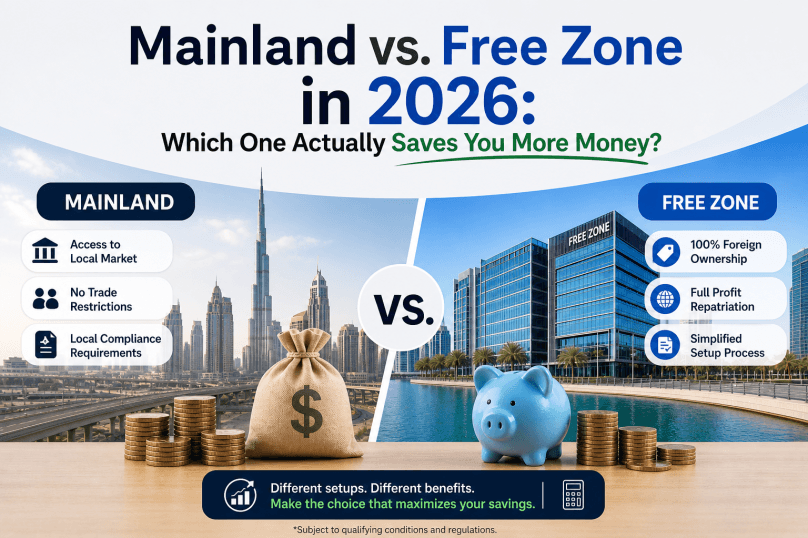
Starting a business in Dubai is a dream for many, but when it comes to the actual setup, one question towers above the rest: Should you choose a Mainland company or a Free Zone company?
At first glance, both options promise benefits like tax efficiency, global reach, and streamlined setup. When working with Recorporate for business setup in Dubai, understanding this comparison becomes even more critical to making the right decision.
Understanding the Basics: Mainland vs. Free Zone
Before comparing, let’s simplify what each structure means.
What is a Mainland Company?
A Mainland company is licensed by the UAE government to operate anywhere in the country and even internationally.
- Can trade directly within the UAE market
- No restriction on office location
- Eligible for government contracts
- Flexible business activities
What is a Free Zone Company?
A Free Zone company operates within a specific economic zone designed to attract foreign investment.
- 100% foreign ownership
- Tax benefits
- Simplified setup process
- Limited direct access to UAE mainland market
The Real Question: Where Do You Save More Money?
Let’s be honest—saving money isn’t just about setup cost. It’s about:
- Initial investment
- Operational expenses
- Taxes
- Scalability costs
We’ll break each of these down in detail.
1. Initial Setup Cost: The Upfront Reality
- Free Zone: You often get “All-in-one” packages (License + Virtual Office + Visa). In zones like SHAMS, IFZA, or RAKEZ.
- Mainland: This requires DED license fees, a physical office (Ejari), and various government approvals.
The Verdict: If you are a lean startup with limited capital, a Free Zone offers a lower barrier to entry. However, the “savings” can be deceptive if your business model doesn’t fit the zone
2. Market Access: Where Will Your Revenue Come From?
Saving money isn’t just about spending less; it’s about earning more efficiently.
- Mainland: You have the freedom to trade anywhere in the UAE, including lucrative government contracts. There are no geographic restrictions on where you can pick up clients.
- Free Zone: You are technically restricted to trading within your specific zone or internationally. To sell goods or services directly into the UAE Mainland, you may need a local distributor or agent who will take a significant commission.
Hidden Cost: If your primary customers are in Dubai or Abu Dhabi, the commission paid to distributors in a Free Zone setup will quickly outcost the higher fees of a Mainland license.
3. Physical Office vs. Flexi-Desk
In 2026, hybrid work is the standard, but UAE law remains specific about physical presence.
- Free Zone: Most zones offer “Flexi-Desks” or “Smart Offices.” These satisfy the legal requirement for a license at a fraction of the cost of a real office.
- Mainland: A physical lease agreement (Ejari) is mandatory. While this adds to your overhead, it also increases your “Visa Quota”—allowing you to hire more staff as you scale.
4. Corporate Tax & Compliance (The 2026 Factor)
- Free Zones: Some “Free Zone Persons” can still benefit from a 9% tax rate on “Qualifying Income.” However, the compliance requirements to maintain this status are rigorous and often require expensive auditing.
- Mainland: You are subject to the standard 9% tax. While you pay more in tax, the accounting and compliance structures are often simpler and more straightforward.
Success Is About Foundation, Not Just Registration
Many entrepreneurs fall into the trap of “cheap packages,” only to realize six months later that they cannot open a corporate bank account or that their license doesn’t allow them to rent a warehouse.
At ReCorporate, we don’t just sell licenses; we build Business Foundations. We analyze:
- Your specific business activity and target market.
- Which jurisdiction will make your corporate banking process smoothest.
- Your 3-year scalability plan to avoid “re-registration” costs later.
Final Thoughts: Which One is Your Winner?
- Choose Free Zone if: You are a freelancer, a digital nomad, an international consultant, or an e-commerce business focusing on global markets.
- Choose Mainland if: You want to open a physical shop, a restaurant, a construction firm, or a service agency targeting local UAE clients.
Don’t make a choice based on today’s price—make it based on tomorrow’s growth. The cost of fixing a wrong setup is always higher than the cost of doing it right the first time.
Ready to build your legacy in Dubai? Contact ReCorporate today for a strategic consultation that puts your business first.
Frequently Asked Questions (FAQs)
Q1. What is the main difference between a Mainland and a Free Zone company in Dubai?
A Mainland company can operate anywhere in the UAE, while a Free Zone company mainly operates within its designated zone or internationally.
Q2. Which business setup option is cheaper in 2026?
Free Zone setups are usually cheaper at the beginning because they offer package deals with licenses, visas, and flexi-desks included.
Q3. Can a Free Zone company do business in the UAE mainland?
Yes, but in many cases, a Free Zone company may need a local distributor or additional approvals to trade directly in the UAE mainland market.
Q4. How can ReCorporate help with business setup in Dubai?
ReCorporate helps businesses with Mainland setup, Free Zone registration, corporate banking assistance, licensing, and long-term business planning in the UAE
Q5. Which option is better for startups and freelancers?
Free Zone companies are often better for startups, freelancers, consultants, and online businesses because of lower setup costs and easier registration.